Friday, 18 June 2010

It's going a bit quiet now...


It's been a quite week for me, with night shift curtailing any real birding opportunities. Thankfully (?) the drift migrants are starting to dry up, with only a single male red-backed shrike being of note in Northumberland... so nothing too good missed. The quail did not linger at West Hartford.

This afternoon the garden has been a hive of activity, with the female blackbird clearly having to tend to a second brood, while the family of dunnock are fledged and being fed in the shade of the garden border...


Hopefully I'll get out over the weekend.

Friday, 11 June 2010

Pit pil-it...

This evenings visit to West Hartford was enlightened by the presence of a new Cramlington bird species...


Quail!


A single bird was initially heard singing from the A192 near the West Hartford farm buildings... then Gordon called to say he could hear one, if not two from the road end to the east of the pools!

A Cramlington birders "semi-twitch" ensued, resulting in a count of 2 to 4 birds singing.

All the birds can easily be heard from the roadside / business park road. There is no need to walk into the fields. If you walk in the field you will not see them, so don't bother!!!! (Please, there is enough hassle for the breeding reed bunting, sky lark, meadow pipit, grey partridge etc from the fox and dog walkers that frequent the area... size 10 boots need not venture on a fruitless mission......)

A great result for the patch.

A great start to the weekend.

Saturday morning update: Already the infamous mp3 player has been and failed. Why bother????

Tuesday, 8 June 2010

Marsh acro...

I really struggled to get anything decent on the Druridge marsh warbler this afternoon - a combination of dull light and a very tricky and elusive bird, so a record shot it is... While I was there he mimicked chaffinch, greenfinch, goldfinch and an alarm calling blackbird!
First time I've seen one in reeds, although in fairness it was commuting between the reeds and the willows, often associating with a single reed warbler.

(Image updated on 11 June...)

Monday, 7 June 2010

Neat Neat Neat


Sunday 6th June: spent a quiet and relaxing evening with THE DAMNED!!!!!!


Captain Sensible: stole the show!!


Wait For The Blackout

Disco Man

I Just Can't Be Happy Today

Perfect Sunday

Thrill Kill

Love Song

Neverland

Gun Fury

Eloise

Limit Club

Song.com

New Rose

Fish

Bad Time For Bonzo

Shadow of Love

Neat Neat Neat


Stretcher Case

Fan Club

Melody Lee

Satisfy You

Thanks For The Night

Happy Talk

Smash It Up

Tuesday, 1 June 2010

BH@WH

Bank holiday Monday saw me at West Hartford a few times.

The morning visit was dominated by the return of the immature marsh harrier, albeit very briefly at 08:15, putting all the gulls up off the flash and being chased off by the carrion crows. The harrier drifted north-east and appeared to follow the River Blyth. I guess it may stick around.

Three ringed plover  increased to four by the evening, a number that I was happy with until I saw an email off LMcD this afternoon - he had 14 (site record, probably) later on Monday evening. Two grasshopper warbler continue to "reel" and the Crowhall Lane roundabout is holding at least one singing garden warbler. The evening visit included a fly-over common buzzard, but no sign of the barn owl.

Tuesday afternoon included a brief visit after work, shelduck numbered 4, lapwing 28, ringed plover 2 and a few lbbg, hg, bhg and a single common gull.

***

As I write this I receive a few text message from my mate Sacha in Norfolk, he's just dipped the East Bank trumpeter finch after a long convoluted trip on public transport. (And its come back after he has left.....) Bit of a pain that, though he'll not be too disappointed as he found the Blakeney Point bird a couple of years back! If this bird does remain, it will be tempting to take a trip down at the weekend, especially if other drift migrants are available.

The bird in the photograph here is that of the June 2005 individual at Dungeness, Kent - seen after a long overnight drive south with Tom, photographed early morning under a garden feed station. 

Sunday, 30 May 2010

Update from the patch...

After missing the West Hartford temmincks stint earlier during the week (it had chosen to be found just as I was leaving for nightshift..., flying off that night, no sign on Thursday but one common sandpiper to compensate etc...) I've realised I need to keep a closer eye on the patch.

It has been an early start on both Saturday and Sunday, and the birding has been ok to very good by Cramlington standards.

Three visits to West Hartford on Saturday gleaned the following: two ringed plover, four shelduck, grasshopper warbler, two grey-lag geese and one obliging barn owl (no camera!!!).

Early morning Saturday at Arcot Pond produced 2 grey-lag geese (probably the birds at West Hartford later that evening), a family of Canada Geese (four goslings survive), lesser whitethroat, common tern, sedge warbler and curlew. Great-spotted woodpecker continues to be conspicuous.

A tip off from Phil earlier in the week led me to the fields near the Plessy windmill, where after a bit of scanning, my first red-legged partridge in Cramlington was picked up. What a delight!... (a temmincks stint would have been better though...). Yellowhammer were also singing in the area.

Sunday birding has commenced as early as that on Saturday, with two trips to West Hartford by 09:00. Undoubted highlight was the text from Gordon, just as I was pulling up onto the roadside verge for vist number two: Marsh Harrier at West Hartford!!!!!


I jumped out the car and within a few seconds, thanks directions from Gordon, I was watching my third marsh harrier on the West Hartford patch and my 4th in Cramlington. By the looks of it its' an immature, probably on a summer wander... And wander it did, having lifted from the field it attracted unwanted attention from the carrion crows and gradually increased height, being lost to view north of the River Blyth.

As the harrier departed a cracking fox arrived...


Followed closely by a single roe deer...


Lindsay McD arrived a little later (probably best not to post a picture here ;-), as did a single ringed plover, three oystercatcher and a pair of mallard.

Inbetween the two early morning vists to West Hartford I had been back to Arcot - which was quieter than on Saturday, though a non singing grasshopper warbler was on view briefly and stock dove were kicking about.

More later?... 

Tuesday, 25 May 2010

Lame Stint!

Monday afternoons plans to wash the car were shattered when the pager announced at 14.27  that there was an interesting stint sp. not to far down the road at Lamesley - in fact it was being put out that the aforementioned bird was a possible long-toed stint.... So, with a rinsed car that dried very streaky, I made my way south on the A1. Passing Gatesheads' Metro Centre news was broadcast that the bird was still present, but was thought to be a probable little stint...
A few were gathered at the site and it was clear that the bird was interesting - loosely associating with little ringed plover, this apparent pale legged bird has a nice white supercilium and rufous looking cap. In flight it was noted by others that the toes did not seem to project, but no one realy was committed to making a judgement!

I put a couple of images on Birdforum last night (note that the record shot was taken with both 1.4 and 2.0 convertors stacked, so pretty poor!!) and some video also appeared on Youtube... and not too long later opinion seemed to settle on little stint. Just shows, stint id' isn't too easy... Anyone remember the 1989 bird at Saltholme??? (think it turned out to be a presumed hybrid... pec sand * dunlin if I remember correct?)

Onwards....

Sunday, 23 May 2010

Sunny on the patch...

It's been a beautiful sunny weekend in the north-east of England and birding has been rather restricted.

Saturday morning started early, with the final Mauritius blog images posted. By 07:00 I was at West Hartford enjoying the song of grasshopper warbler, lesser whitethroat, garden warbler, willow warbler, whitethroat and blackcap. Two canada geese were on the pool edge and a single shelduck stood amongst the gulls. A single greenshank scooted along the mud.

At Arcot the warbler activity was simlar, with sedge dominating the proceedings. Great-spotted woodpecker were clearly feeding young and a pair of canada geese has 4 young. One common tern was feeding over the pond.

Mid-morning saw me head north to Stewarts stomping ground, where good banter was shared with Stewart and Alan. No sign of the rosefinch though, as Stewart has already written, the arrival of lawnmowers into the gardens may have forced retreat...

It was a lazy afternnon, I spent most of it getting burnt in the garden!

Sunday dawned just as bright and warm as Saturday, and it was pleasing to have to dash out to West Hartford to "tick off" my first garganey on the site. A nice addition, though not unexpected, to the patch list.

Early afternoon was spent sprucing up a new header image for the blog - predominated by the June 2008 lesser grey shrike that was present on the Long Nanny, a stunning bird indeed.

While the rest of the UK is enjoying a flurry of decent birds... broad-billed sandpipers north and south, iberian chiffies continuing and bee-eaters in many locations, I wonder when the north-east will score for a spring overshoot? Soon...?

Saturday, 22 May 2010

Resort Birding


Most of the bird species around the resort in Mauritius were introduced and of standard holiday fare - common myna were very abundant and noisy, while the bold red-whiskered bulbul (right) came a close second.

A small stream near the resort entrance was checked a couple of times per day and produced most species, including village weaver, common waxbill, nutmeg mannikin, madagascar fody, spotted dove, zebra dove, madagascar turtle dove, yellow-eyed (also known as yellow fronted) canary and the familiar house sparrow.

Of more interest was the native species. In the resort this comprised of the most common endemic - Mauritius grey white-eye - an odd white-eye without a white eye / eye ring! Very tricky to photograph (see below), they had a knack of staying just within the foliage, obscuring a clear view! This species would often be found in small parties, typically 2 - 4 birds, and were generally very active.


Mascarene martin (below) were present, and appeared to be nesting at the hotel next door. I spent a morning waded out into a tidal channel trying to get some decent shots, but this species beat me! This species reminded me a little of purple martin...


Also available were the occasional striated heron (often feeding on the stream, most commonly on the shore-line), and an occasional fly-over white-tailed tropicbird.


Above - Yellow Eyed (Fronted) Canary
Below - Village Weaver


Late afternoons were spent checking out the sea ~ walks up and down the coast produce small numbers of whimbrel, while offshore there were good numbers of common noddy and a single sooty tern was logged.


Above - Common Waxbill

Mauritius is a fantastic place... it's certainly not a place to visit for high numbers of bird species, but in terms of endemics it has some real treats and this visit may have given me my only ever chance to see pink pigeon, echo parakeet, Mauritius olive white-eye... Combined with stunning scenary, the best fish I've every tasted (and Rhum I've drank!) and very friendly locals it comes highly recommended as a holiday destination.

Friday, 21 May 2010

Final Tail


Last of the white-tailed tropicbird images to be posted... promise!

Next up... some of the birds around the resort.

Thursday, 20 May 2010

Black River Echo

Our base in Mauritius was in the Bel Ombre area, located in the south-west of the island and close to the last native forested areas of Black River Gorges National Park.

The park extends over 6,754 hectares, covering about 2% of the island’s area and holds 9 species of birds, which are found only in Mauritius. So that was enough incentive to explore the area!


Armed with some of Charlie Moores trip details from a few years back we headed to the Le Petrin visitor centre and took an easy walk along the Macchabee forest ridge. Many of the introduced bird species were seen frequently along the trail including red-whiskered bulbul and rose-ringed parakeet. It was however another parakeet species that was of more interest...


It was a really hot day but the views enabled us to forget the sweat dripping...! The gorge was exceptionally deep and their were some wonderful views of waterfalls.


Above - failing miserably to photograph Mascarene Swiftlet...

In the gorge white-tailed tropicbird dominated and were a pleasure to watch, their tails were amazing!


Nearing the Macchabee viewpoint were finally heard the deep croaking call of one of our target species, and a few seconds later a pair of the endangered endemic Mauritius echo parakeet flew past. Phew! The male bird is essentially similar to rose-ringed, with the deeper call being the most reliable distinguishing feature, while female birds have a conveniently all dark bill - see the record shots in this post.


Above - male Echo Parakeet
Below - Female Echo Parakeet


While we did not manage to see any Mauritius kestrel, a single Mauritius bulbul was seen (near the Black River Gorges Viewpoint), so it was a relatively successful visit... certainly recommended for the views alone.

Wednesday, 19 May 2010

Ile aux Aigrettes ~ few more...


Above - Madagascar Fody - abundant on Mauritius and more colourful than the native Mauritius endemic
Below - Aldabran Giant Tortoise ~ 50 year old and 200kgs! Introduced on Ile aux Aigrettes to "naturally" graze the land. Replaced a native species that became extinct, but maintains the eco-balance.


Telfair Skink - only found un the wild on Round Island, introduced to Ile aux Aigrettes.

Tuesday, 18 May 2010

Mauritius: Ile aux Aigrettes


Prior to the trip to Mauritius I was fortunate to have stumbled over Charlie Moores wonderful tale describing his visit to Ile aux Aigrettes, a tiny island off the south-east coast of Mauritius. This island has been utilised by the Mauritius Wildlife Foundation to re-establish some of the areas most threatened bird species.

We booked a visit upon arrival on Mauritius, and the mention that one of the party (me!) was a birder secured us a private tour with a warden who specialised in the bird species present.

Our landing on the island was greeted with the first of many Mauritius Fody - a cracking start! This species was introduced to the island in 2003 and now supports a population of over 100 birds. Considering that the MWF website states:

 "The Fody is the rarest endemic bird of Mauritius with 100-125 pairs remaining and is considered Critically Endangered by the International Union for Conservation of Nature (IUCN). In 2002 MWF began a recovery project to rescue nests from the wild, hand-rear the offspring and release them onto Ile aux Aigrettes, a predator-free offshore island under the conservation management of MWF. This project has been very successful and today there are around 100 birds on Ile aux Aigrettes, the result of releases and offspring produced by the latter".

- So Ile aux Aigrettes is possibly the best place to encounter this species.


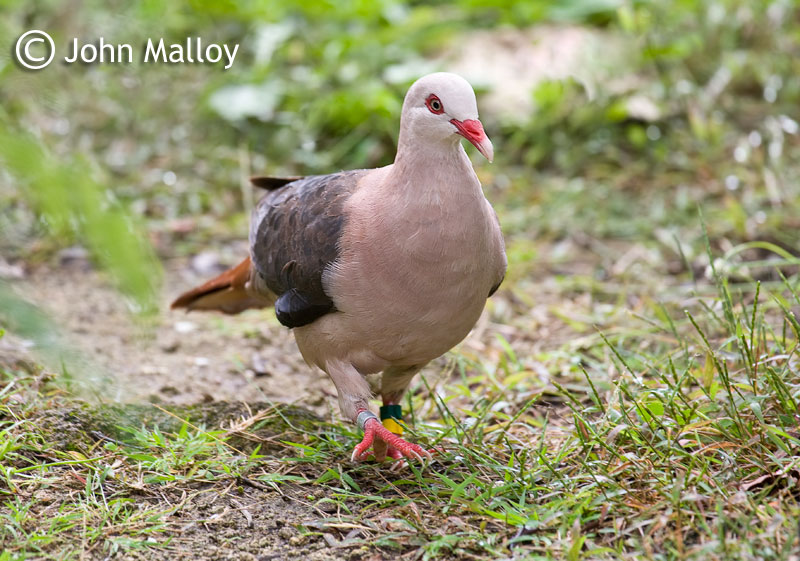
Mauritius Pink pigeon now numbers an entire population of 320 birds, a pleasing rise from the population of 12 in 1986...


I had visions of many photo opportunities with pink pigeon, but alas it was not to be - our initial bird, an immature teased us from a viewing platform, while this adult greeted us on a heavily vegetated track - so record shots were only achieved before the bird lifted with nesting material. A stunning species nonetheless!! Pink pigeon is a very rare bird indeed, Birdlife International list the species as "endangered", while the MWF now cites 5 sub-populations on Mauritius.
The final endemic bird species seen took a little more effort - but thanks to the assistance of a second warden we finally connected with the critically endangered Mauritius olive white-eye....


... and what a tricky species this prove to be to photograph!


Two birds were present but very elusive. This species was only very recently introduced to the island and still maintains a very small breeding population. Birdlife International state that the current population is in the region of 190 - 296, with approx 36 on Ile aux Aigrettes.

An amazing morning...