Showing posts with label Cape Town. Show all posts

Tuesday, 24 January 2012

South Africa - birdy pics and a few words...

It's tricky to select images for use on the blog - photographs of some of the better South African species have suffered to the heat haze, so a random selection will be posted rather than a chronological sequence.

Juv common fiscal, Franschhoek
 Our first four days in Franschhoek were based on a delightful vineyard - birding was restricted to species seen while out on the bike, so no camera was carried. The common fiscal was outside our residence on a very hot afternoon and allowed sufficient approach for the 100-400mm lens.The adults are cracking in comparison - jet black and pristine white plumage!

Black-shouldered kite, north of Cape Town
 Fast forward to Cape Town, out home for the last 4 days. Day 2 and 3 were spent with Birding Africa. Our guide, Alistair Kilpin was superb! Just north of Cape Town we pulled over off the highway to scan a small pool - it was full of birds! Two black-shouldered kite were perched in a dead tree - lush is the only way I can think to describe them! We also enjoyed bokmakerie, hottentot teal, marsh sandpiper, purple heron, yellow bishop, our first of many white-backed mousebird to name a few - it was avian overload!

Yellow-billed kite, Geelbek, West Coast National Park
 After great stops for secretarybird and the Darling track (blue crane, capped wheatear, red-capped lark, african stonechat, and our main quarry - 3 vocal and active southern black korhaan) and some wetland viewing at Velddrift (greater and lesser flamingo, caspian tern, pied kingfisher, thick-billed lark, waders galore) we hit West Coast National Park.

WCNP is beautiful... and views of the lagoon at Langbaan were picture postcard perfect - azure waters and pure white sands. Stops along the road were productive - two female southern black korhaan just avoided the camera as they lifted off the road and karoo scrub robin entertained.

Birding the lagoon wasn't bad either! 5 damara tern were roosting with the plentiful common and sandwich, while white-fronted and kittlitz plover scuttled in front of the hide.

Late lunch was at Geelbeck, and jolly good it was too - hake and calamari hit the spot, while cape weaver, yellow bishop, cape spurfowl and a brief male pin-tailed whydah entertained between and on the dinner tables!

Cape weaver, Geelbek, West Coast National Park
 No sign of any black harrier on our visit, the only "miss" of the day. Compensation was in the form of a plethora of new birds for me, so I cannot grumble! The water hole at Abrahamskraal was very good - I missed photographing a close black crake (there were several on the far shore), while cape bulbul, yellow canary african sacred ibis, african spoonbill, lesser swamp warbler kept us busy.

Our exit from the park included a flyby European bee-eater and many ostrich.

Red-knobbed coot, Abrahamskraal water hole, West Coast National Park
Our day completed almost 11 hours after the hotel pick-up, 110 species richer for the holiday. Fresh air had knocked us for six and it was a jolly good nights sleep...

Friday, 15 January 2010

Cape Town ~ final post!

Speckled Pigeon

Hadeda Ibis


Laughing Dove

Cape Wagtail

At last, the final Cape Town post.
A few more of the common birds to feature on the trip.
The speckled pigeon was photographed under the hotels' canopy, it appeared to have a nest up there. This was a very abundant species, and is colourful at that.
The hadeda ibis was photographed on the edge of the golf course at Green Point - they're subtly colourful. Often seen in small foraging groups and quite bold.
The laughing dove was photographed on the waterfront and was barely noticeable as it fed quietly between the boulders.
Finally, cape wagtail. A common resident and seen throughout our visit. These birds can move real fast - it was quite a challenge to get an action shot! Probably more interestingly, this shot was taken just after the UK comedian Jimmy Carr had walked past, en route back to his hotel. I guess it was a highlight of his trip passing us photographing cape wagtail?!
South Africa was a wonderful trip, certainly a place I'd head back to.

Robben Island Circular

Crowned Cormorant

Cape Cormorant


White-chinned Petrel

As I mentioned earlier some pre-booking of excursions would have been wise, as we were unable to get onto one of the Robben Island landings during our stay. As a compromise we took a "round the island" cruise on a rather smart catamaran. Highlight of the trip for me was the opportunity to see a few more bird species while taking in the views of Robben Island and Cape Town/Table Mountain.
In the Victoria and Alfred harbour hartlaub's gull, cape gull and swift tern dominated the proceedings, while offshore the birding got a bit more interesting.
My first african penguin encounter was relatively quick into the journey, with many parties noted throughout. Cormorant species were also available - teams of cape cormorant flew by, with lesser numbers of crowned and bank cormorant noted. Flocks of african sacred ibis commuted between the mainland and the island, I assume there is good feeding to be had there.
Rounding the island our boat put up a single white-chinned petrel - a few record shots were rattled off... and it was not to long after that when the first cape gannet appeared.
Arctic skua and common tern were reminders of home, although the warm blustery conditions were not!


Thursday, 14 January 2010

Hartlaub's Gull


.... a couple of images of hartlaub's gull, a very common endemic resident. Photographed on the Victoria and Afred Waterfront.

Wednesday, 13 January 2010

Kirstenbosch non-capers


Some additional images from KBC, with (from the top) african dusky flycatcher, karoo prinia and helmeted guineafowl. Strange to be posting images from sunny days as it continues to be dark, cold and starting to snow in the north-east of England...
The flycatcher and prinia pictures were taken in a corner of the gardens that was a hive of activity - the cape batis and cape white-eye images in the previous post were taken at the same spot, just up from Camphor Avenue where we had failed to locate the gardens resident spotted eagle owl. Also present here were cape robin-chat, hadeda ibis and lesser double collared sunbird.
There were many signposts in the gardens warning children not to chase the guineafowl as they had a reputation to retaliate! I'd have loved to have seen that as we saw many a guineafowl running frantically away from kids screaming "get it!!!!" throughout our visit.

Next up will probably be some mop-up species to complete the trip, focusing on birds from around the Victoria and Alfred Waterfront in Cape Town.

Tuesday, 12 January 2010

Kirstenbosch Capers


More images from Kirstenbosch Botanical Gardens - all "cape" birds. From the top: cape batis, cape francolin, cape bulbul and cape white-eye.
I had expected the photography to be much easier than it actually was at KBC, and did not have any luck with sunbirds nor sugarbird.
The cape batis shot was literally a grab shot as this bird flicked past and the cape white-eye and bulbul were record shots as they tended to keep high up (bulbul) or feed actively and too close! (white-eye). The cape francolin was much more obliging, stopping off for a dust bath inbetween feeding with its' family.


Sunday, 10 January 2010

Kittlitz's Plover


A walk along the beaches on the Atlantic coast west of Cape Town found us watching a family of kittlitz's plover - a very dainty and attractive species. The juveniles (two) had an uncanny knack to disappear under the seaweed and were actually very difficult to see as they scuttled across the shingle.

Saturday, 9 January 2010

Af.B.O.

Male


Male

Female


There will not be much in the way of birding this weekend with heavy snowfall again dominating the north-east of England. Got to say I'm loving it, not to good for the birds mind... Yesterday I followed a tip from Phil, who had seen water rail up close at West Hartford - I had no luck but did see the footprints! On the Horton Burn 2 snipe and single moorhen and kingfisher were present.

Photographs today feature african black oystercatcher - these images were taken on 1st January 2010 on the coast near Cape Town. It was part of our annual "New Year" walk, something we always seem to end up doing after a night of celebration.

Note how the african black oystercatcher have different bill length? The male has a shorter, chisel ended bill, while the females' is longer and more pointed - this provides subtle variations in their diet.

African black oystercatcher breeds only on the coasts and islands of South Africa and Nambia and has a population of about 7,500 birds ~ an increase of about 25% since the 1980's as increased protection of their breeding habitat, and rather bizarrely, the arrival of of mussels derived from the Mediterranean! (this goes against the grain from most alien species - bare in mind the disastrous affects of alien species in Hawaii?)

Friday, 8 January 2010

Strandfontein: 40 Minute Bonanza!

Greater Flamingo - large flocks present, no lesser flamingo picked up though...

We ended our trip out on 31st December 2009 at the un-touristy location of Strandfontein sewage works (!). Our driver had been a little doubtful of my request earlier in the day ("are you serious??"), but as traffic was quieter than expected we could afford a very quick visit. We approached from Muizenberg and headed along the impressive beach hugging R310 east to the M17 - loads of cape gull flew over the car as we approached. The sea in False Bay had some great crashing waves.

After our sign-in at the Zeekoevlei check point we headed south into the complex, picking up great white pelican immediately. Good start!


Cape Teal

At the "pan", greater flamingo were very numerous and provided a great show for my non-birding companions (despite the stink of the sewage works!).

The pools were also very well stocked with wildfowl, and it was tick after tick for me, with cape teal, red-billed teal, cape shoveler, maccoa duck, red-knobbed coot and on the reed fringed edges, levaillant's cisticola were readily available.


Cape Shoveler (drake on right, note his yellow eye!)

The supporting cast wasn't bad either - a big flock of blacksmith plover loitered on the roadside, while hadeda ibis, glossy ibis, african sacred ibis and little & cattle egret scattered from roadside ditches as the car drifted past. An african marsh harrier quartered the pools, with black-crowned night heron, grey heron, black-headed heron, african purple swamphen, black-winged stilt and avocet plodded round the pool edges. Black-necked grebe were very numerous (I've never seen so many together before), with lesser numbers of great-crested and little grebe in support. This was truly amazing!!


Blacksmith Plover - highly attractive wader, thankfully common too!

Cattle Egret - loads feeding near the road network

Barn swallow and white-throated swallow hawked over the pools and pied crow were numerous too.

As previously mentioned in this post, it was a quick visit - certainly no more than 40 minutes... I could have easily spent a full day here... the Southern African Birdfinder book states that on a summer day 80 species are easily available at this site, while the record by the authors stands at 118... in one morning!!!.

We left picking up a modest 33 species from the car, 10 of which were brand new species for me... extremely rewarding, and perhaps a timely reminder for me to book a hire car in advance of a trip - I could have seen much more had I booked...
So that was the end of our tour, it was back into Cape Town for the New Year celebrations and some nice red wine!

Thursday, 7 January 2010

Boulders Beach = Penguin's Galore!

African Penguin


... in from the sea

After a very nice lunch on the 31st December we headed to the famous african penguin colony at Boulders Beach, Simonstown.


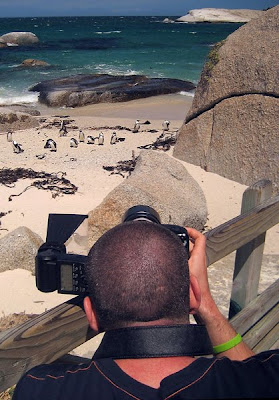
This was a great experience, as the penguins were very, very close to the raised board-walk!


Great views from the boardwalk! (must remember to photoshop the grey hairs next time...)

What characters these birds are, a real hit with the tourists, birders and non-birders alike. In fact, I'm betting that african penguin is Mrs Birdingsometimes' new favorite bird.
This site is the larger of two mainland colonies of this globally threatened penguin, with approximately 1,000 pairs. It's remarkable to think that the first pair only nested in 1985.

The bulk of the penguins were loafing about on the sandy beach and were occasionally joined by small groups returning from their fishing trips in False Bay.

Two blacksmith plover (love these!), a cape gull and hartlaub's gull were also present on the beach, while swift tern and common tern fished offshore.

With our fill of penguins we headed north towards Cape Town, passing through Fish Hoek and and Kalk Bay. False Bay has some beautiful beaches...

Next stop? Where else would you choose to take your missus and bemused driver on New Years' Eve afternoon....? At Strandfontein Sewage Works of course!!

Wednesday, 6 January 2010

Cape Capers

On the 31st December we headed out to Cape Point / Cape of Good Hope, heading south from Cape Town via Hout Bay. As we were unable to hire a car we chartered a private tour - giving access to the point but without the convenience of stopping exactly where we wanted... better than nothing I guess! The drive was dominated with beautiful scenery - high mountainous landscape and gorgeous beaches. Bird-wise it was fairly quiet, with southern boubou, african black oystercatcher, jackal buzzard, cattle egret etc noted on the drive.
Familiar Chat


At the Cape, rock martin were common and there were plenty of cormorants - mainly cape and white-breasted. A few orange-breasted sunbird flicked about, red-winged starling were numerous and my only cape sugarbird was seen from the moving car!! Familiar chats were abundant. Along with not seeing cape grassbird, cape bunting was also dipped.

Chacma Baboon


Highlight(s) of the visit were the more "non-birder attractions", namely the chacma baboons and feral common ostrich!! The baboons were frequently encountered on the access road, while common ostrich were seen from the coastal path that links Cape Point and the Cape of Good Hope ~ additional birds, including the birds featured in the photographs below were seen on the roadside. By golly they're big!

Cape of Good Hope - beautiful!


Common Ostrich

Common Ostrich - see next picture below for how it was photographed!


Photographing common ostrich from the car...

Dodgy character checking out the sea at the Cape of Good Hope - we left the coastal path sandblasted!

Out at sea several cape gannet were observed along with cape and hartlaub's gull. Cape fur seal were also present.
With the walk to the Cape of Good Hope complete, we headed north for lunch near Simonstown, ensuring we were well fed for part two of the drive...

Tuesday, 5 January 2010

Table Mountain

Neddicky

Lizard Sp. (Southern Rock Agama?)

Red-winged Starling

Rock Hyrax

Orange-breasted Sunbird

The 30th December saw us hike up part of Table Mountain, walking from the lower cable car station via Platteklip Gorge. It was a great walk and provided some lovely views of Cape Town - some pictures will no doubt follow at some point.

From a birding perspective it was moderately successful, with neddicky and rock kestrel noted near the lower cable car station, familiar chat, african black swift, cape robin-chat, cape siskin and orange breasted sunbird nearing the table top.

On the top of the mountain, three plus white-necked raven patrolled, with red-winged starling, speckled (rock) pigeon and african black swift were abundant. A couple of orange breasted sunbird provided photograph opportunities, but the weather soon turned as thick cloud shrouded the mountain, dropping the temperature too. I failed to locate any cape grassbird - an annoying dip for the holiday as none were seen at the Cape of Good Hope either.
There were plenty of odd coloured lizard "species" - can anyone id the one in the photograph?, and rock hyrax were also present, no doubt enjoying scraps from the upper cable car station cafe.
We took the easy option for our descent, travelling in the comfort of the cable car.

Monday, 4 January 2010

Cape Canary

Monday 28th December was spent wandering the very impressive 528 hectare Kirstenbosch Botanical Gardens. This site on the eastern slopes of Table Mountain only contains indigenous South African plants, a feature that makes the location very attractive to Cape bird species. The visit was high on my agenda during the holiday.

This cape canary was part of a small flock feeding near the visitor centre - and although approachable, reminded me of the challenges of bird photography in strong sunlight - shadows become a nightmare!
Image was taken using the 100 - 400mm IS lens along with fill flash.

Sunday, 3 January 2010

New Years Eve 31.12.09 / On the beach

African penguins head back to shore at Boulders Beach, South Africa.
Image courtesy of Mrs Birdingsometimes. (Canon PowerShot SD600 "point and click jobbie")
More images of the penguins soon...